


 /
/ 
 Print
Print
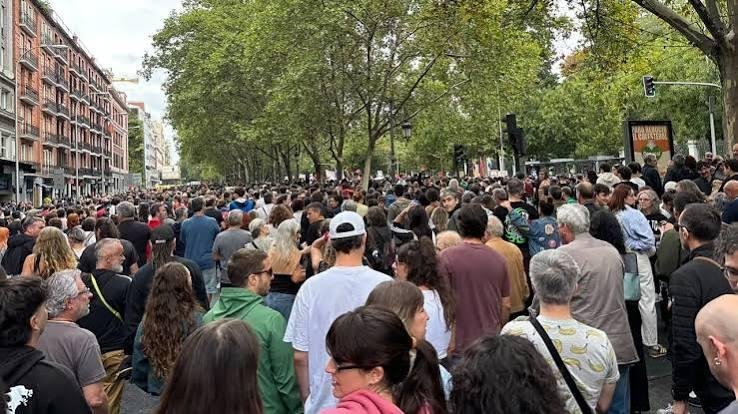
Hundreds of thousands of people took to the streets across Spain on Saturday to protest the country’s housing crisis. Demonstrations were held in Madrid and several other cities, with protesters demanding lower rents, stronger tenant protections, and affordable housing for all.
Organizers said around 500,000 people joined the protest in Madrid. Authorities, however, estimated the turnout at about 70,000. Protesters chanted slogans calling for lower rents and changes to the housing system, while many carried signs outlining their demands.
The demonstrations were largely peaceful. However, tensions rose in Madrid when some protesters moved police barricades and threw objects at officers. Police responded with rubber bullets and tear gas to disperse the crowd. Several protesters also climbed onto part of a building.
Housing activists have been occupying Madrid’s popular tourist area, Puerta del Sol, for nearly a week. Saturday marked the seventh night of the protest, with organizers estimating that about 2,000 people were there.
The demonstrations are being coordinated by the Tenants’ Union, which is calling for a 50% reduction in rents, open-ended rental contracts, and the return of homes owned by large investment companies to the housing market.
Valeria Racu, a spokesperson for the organization, said there is a growing disconnect between what ordinary people want and the decisions being made by political parties in Parliament.
Protests were also held in Valencia, Barcelona, San Sebastian, Cadiz, Las Palmas de Gran Canaria, and several other cities. In Valencia, protesters marched toward a housing investment conference. The situation became tense after some demonstrators broke through police barriers and threw objects at officers.
The protests came a day after Spain’s Parliament rejected two government proposals aimed at strengthening tenant protections. The first proposal was rejected by a vote of 178 to 172, while the second was defeated 184 to 166.
The opposition People’s Party, Vox, and UPN voted against the proposals, while Junts abstained.
The parliamentary defeats have increased political pressure on Prime Minister Pedro Sanchez. He is reportedly considering calling an early election, while opposition parties have also called for a new vote.
Junts, however, has urged the government to enter into negotiations. Its leaders criticized the proposals as poorly drafted legislation. The government said Junts’ proposals had already been incorporated into the draft legislation.
Housing Minister and Deputy Prime Minister Yolanda Diaz blamed opposition leader Alberto Núñez Feijóo, Vox leader Santiago Abascal, and Junts leader Miriam Nogueras for the protests and evictions. Feijóo, meanwhile, criticized the government and called for a budget-based solution to the housing crisis.
The latest wave of housing protests was triggered by the eviction of 87-year-old Maricarmen Abascal. She had lived in the home for nearly 70 years. Images of her being carried out of the property on a stretcher sparked widespread public reaction.
Housing rights activists said an investment company had purchased the property and sought to increase her rent by 275%. Following widespread criticism, the new owners later agreed to allow her to return to the home at a lower rent.
The Tenants’ Union has said it is prepared to continue its campaign until its demands are addressed. The groups are also discussing the possibility of calling a general strike.





Like our facebook page
Subscribe our YouTube channel