


 /
/ 
 Print
Print
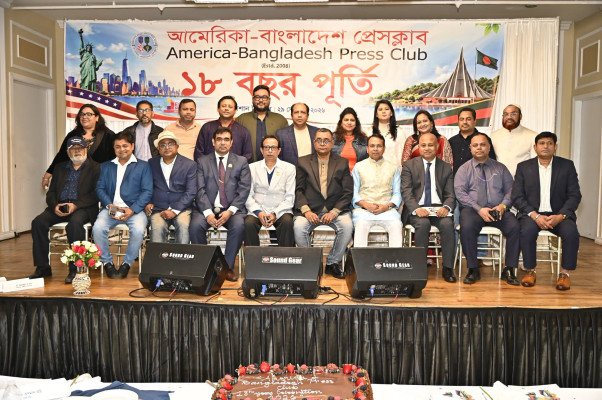
The America-Bangladesh Press Club marked its 18th anniversary with a seminar and cultural program in New York.
The seminar was held on Tuesday, September 29, at Gulshan Terrace in Woodside. The theme of the discussion was “The Global Media in Crisis.”
Speakers at the seminar discussed the state of the media in Bangladesh, the professional experiences of Bangladeshi journalists living in the United States, and the changing trends and strategies of the media industry worldwide.
Discussing the situation of the media in Bangladesh, speakers said media outlets that engage in political appeasement lose public credibility. They emphasized the responsibility of mainstream media to provide accurate information and said the media must place greater emphasis on independent and investigative journalism while competing with technology and social media.
The seminar was chaired by America-Bangladesh Press Club President Shawkat Osman Rachi and moderated by former club president Darpan Kabir.
Among the guests who addressed the event were Gholam Mortuza, Press Minister at the Bangladesh Embassy in Washington; Mohammad Mozammel Haque, Consul General of Bangladesh in New York; and veteran journalist Manzur Ahmed.
The panel discussion featured veteran journalists Said Tarek and Moinuddin Naser, Bangladesh Patrika Editor Dr. Wazed A. Khan, Jonmobhumi Editor Ratan Talukder, Prothom Alo North America Editor Ibrahim Chowdhury, Probash Editor and former press club president Mohammad Saeed, and Columbia University lecturer Shoaib Ahmed Bhuiyan.
At the beginning of the program, Press Club General Secretary Mashiur Rahman Majumder delivered the welcome remarks. Treasurer Mallika Khan Muna, Vice President Mohammad Manzurul Haque and Joint General Secretary Abu Bakar Siddique also delivered greetings.
To mark the club’s 18th anniversary, a commemorative publication titled “Alokbartika” was unveiled. Its editor, Tofazzal Liton, delivered remarks on the occasion. The program concluded with a speech by Press Club President Shawkat Osman Rachi.
Following the seminar, the anniversary was formally celebrated with a cake-cutting ceremony. The commemorative publication, “Alokbartika,” was also unveiled.
The press club also honored singer M. A. Shoaib and actress Moushumi with special crests. Noted singer Rathindranath Roy presented the crest to M. A. Shoaib, while Press Minister Gholam Mortuza and Consul General Mohammad Mozammel Haque presented the crest to actress Moushumi.
Guests were welcomed with roses on behalf of the press club. During the cultural segment, songs were performed by M. A. Shoaib and Tina Russell. Community leaders, prominent businesspeople and press club members attended the event with their families.
During the seminar, moderator Darpan Kabir read an article titled “How Is the Bangladeshi Media Doing?” written by Matiur Rahman Chowdhury, editor-in-chief of Manab Zamin. The speakers then discussed the issues raised in the article.
Veteran journalist Manzur Ahmed said that if the media engages in misinformation, false reporting or attempts to conceal the truth, people will inevitably turn to social media or other sources of information. He said this would cause the media to lose public trust.
He also emphasized the importance of journalists knowing how to write and regularly reading. According to him, the number of journalists who can properly write news appears to be declining, while journalism focused on making a few comments in front of cameras or microphones is becoming increasingly common.
Bangladesh Embassy Press Minister Gholam Mortuza said media owners and editors bear responsibility for the crisis facing Bangladesh’s media. He said political appeasement has caused the media to lose credibility among ordinary people.
“We have witnessed media outlets flattering the government in the past,” he said. “At one point, however, ordinary people rejected those media outlets.”
He also said mainstream media in the United States has maintained public trust while covering major international conflicts. Referring to coverage of wars in Iran and Iraq, he said U.S. mainstream media outlets have continued to retain the confidence of their readers.
Mortuza said Bangla-language journalists in New York have an opportunity to play an important role by providing accurate information about events in Bangladesh and upholding the principles of mainstream journalism.
Mohammad Mozammel Haque, Consul General of Bangladesh in New York, said people want accurate information and objective journalism.
“If readers truly preferred party-affiliated newspapers, we would have seen those newspapers consistently achieve higher circulation at different times. That has not been the case,” he said.
He said the media must recognize and compete with new forms of communication, noting that this is now the age of social media and people increasingly turn to it for information.
“To meet this challenge, there is no alternative to responsible journalism,” he said. He also emphasized the importance of acknowledging mistakes when incorrect information is published, saying that admitting errors is also a responsibility of the media.
Veteran journalist Said Tarek said journalism in Bangladesh today is no longer what it was during the 1960s and 1970s. He said the nature and definition of journalism have changed, while the rise of social media has created new challenges for media organizations.
“There is a crisis in our media industry,” he said. “Many journalists at different media outlets are not receiving their salaries properly. This crisis is also affecting the practice of responsible journalism.”
Dr. Wazed A. Khan, editor of Bangladesh Patrika, said the media is facing a crisis worldwide. He said readers’ habits and attitudes have changed, while the rise of social media and artificial intelligence has created challenges for print and electronic media.
He said social media often lacks adequate mechanisms for verifying information, allowing anyone to publish almost anything. According to him, mainstream media has an important role in identifying and disproving false information.
“There is a struggle taking place here,” he said. “In Bangladesh, we have seen political control over the media. We are not seeing enough accurate or investigative reporting, nor are we seeing sufficient efforts or competition in that area.”
Journalist leader Moinuddin Naser said journalists must first be honest and that integrity is extremely important in journalism.
“We used to see integrity being valued in journalism. What are we seeing now? The opposite,” he said.
He referred to the arrest of a journalist after the July uprising and said reports that the journalist had 4.4 billion taka in a bank account raised questions about how a journalist could accumulate such wealth.
Lecturer Shoaib Ahmed Bhuiyan said honest journalism is difficult when journalists become overly subservient to powerful interests. Referring to Bangladesh’s economy, he said a country’s economic condition also affects its media and broader social development.
He compared Bangladesh’s economic development with that of Singapore, which became independent in 1965, and discussed the contrasting economic trajectories of the two countries.
Mohammad Saeed, editor of Probash, said Bangla-language media outlets in the diaspora are helping build the community and serving as a bridge by publishing news from Bangladesh.
“Media in the diaspora is also facing a crisis,” he said. “The number of readers is declining, and newspaper publication is also decreasing.”
Ibrahim Chowdhury, editor of Prothom Alo North America, said there is no doubt that the media is facing a crisis, but he cautioned against blaming artificial intelligence or technology alone.
“The crisis has always existed under different names,” he said. “If we put AI or technology in the dock for the current crisis, the real problems remain hidden.”
He said technology has changed, readers have changed, people’s habits of reading, watching and listening to news have changed, and the business model of the media has also changed.
“The definition of media itself has changed,” he said.
Ratan Talukder, editor of Jonmobhumi, said the media has faced problems in the past, continues to face them and will likely continue to do so.
“We should remain vigilant so that false information is not published by the media,” he said.




Like our facebook page
Subscribe our YouTube channel