


 /

 Print
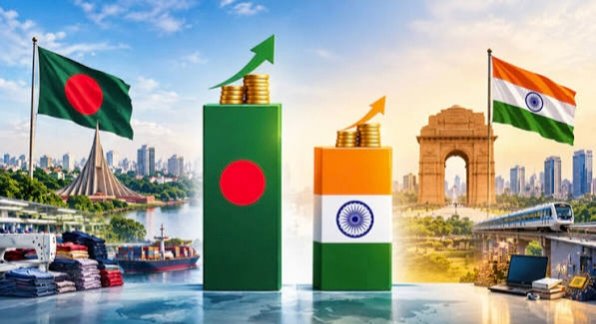
Bangladesh could overtake India in gross domestic product (GDP) per capita this year, according to projections by the International Monetary Fund (IMF). Bangladesh’s GDP per capita is projected to reach $2,886 in 2026, compared with $2,749 in India. However, this does not mean Bangladesh’s overall economy is larger than India’s or that Bangladeshis have greater purchasing power.
An analysis by Al Jazeera says the garment industry, remittances and increased female participation in the workforce have played important roles in Bangladesh’s economic progress. However, high inflation and slowing economic growth are putting pressure on these gains.
What Is GDP per Capita?
Gross domestic product, or GDP, is the total monetary value of all goods and services produced within a country over a given period. Dividing this figure by the country’s population gives GDP per capita.
The indicator provides a broad picture of economic output relative to population size, but it does not directly measure the actual income of every citizen or their standard of living.
According to IMF projections, Bangladesh’s total GDP could reach $506.4 billion in 2026. India’s economy, by comparison, is projected to be worth approximately $4.15 trillion—nearly eight times the size of Bangladesh’s economy.
India Leads in Purchasing Power
Although Bangladesh may have a higher GDP per capita in nominal dollar terms, India remains ahead when purchasing power parity (PPP) is taken into account.
PPP adjusts for differences in the prices of goods and services between countries. On this basis, India’s GDP per capita is projected to reach $12,998 in 2026, compared with $10,884 in Bangladesh.
This means a higher GDP per capita in dollar terms does not necessarily translate into greater purchasing power. The cost of living and local prices also play a significant role.
The two countries also face different inflationary pressures. The IMF forecasts average consumer price inflation of 5 per cent in India in 2026, compared with 8.7 per cent in Bangladesh. This suggests that Bangladesh could continue to face greater pressure from rising prices of everyday essentials.
India’s Economy Growing Faster
Despite Bangladesh’s projected lead in nominal GDP per capita, India is expected to record faster overall economic growth.
The IMF forecasts that India’s economy will expand by 7 per cent in 2026, while Bangladesh’s growth rate is projected at 3.6 per cent.
Bangladesh’s lead in GDP per capita may also prove temporary. According to IMF projections, Bangladesh’s GDP per capita could reach $3,219 in 2027, compared with $3,036 in India.
By 2029, India’s figure is projected to rise to $3,661, while Bangladesh’s is expected to reach $3,334.
What Has Driven Bangladesh’s Economic Progress?
The garment industry has been one of the main drivers of Bangladesh’s economic development over the past two decades. Valued at around $38 billion, the sector plays a major role in export earnings and employment.
Remittances from overseas workers and the expansion of employment in manufacturing have also contributed to the country’s economic growth.
India’s economy, meanwhile, is more diversified. Its technology and business services, industrial sector, agriculture and vast domestic market support economic activity across a wider range of sectors.
Indian economist Santosh Mehrotra told Al Jazeera that Bangladesh had sustained average economic growth of around 6 per cent over an extended period, while its population growth rate had also declined over the long term.
According to figures cited by Mehrotra, manufacturing’s share of Bangladesh’s gross value added rose from 16.6 per cent in 2014 to 22 per cent in 2025.
In contrast, manufacturing’s share of India’s GDP fell from 15.1 per cent in 2014 to 13.5 per cent in 2024.
New Challenges Threaten Bangladesh’s Progress
High energy costs and disruptions to international supply chains have emerged as major concerns for Bangladesh’s economy. The conflict involving Iran, the United States and Israel has contributed to instability in energy markets, while disruptions to shipping through the Strait of Hormuz have added to concerns over global fuel supplies.
Bangladesh imports around 95 per cent of the oil and liquefied natural gas (LNG) it consumes, with a significant share coming from the Middle East. As a result, rising international energy prices can increase import bills and production costs, adding to inflationary pressure.
The country’s heavy dependence on the garment sector also leaves it vulnerable to disruptions in global trade. More than 80 per cent of Bangladesh’s export earnings come from garment products.
Disruptions to shipping routes in the Red Sea and the Middle East have created additional challenges for transporting these goods, raising concerns about the sector’s export performance.
Bangladesh’s ability to sustain its economic progress will therefore depend not only on maintaining growth in key industries, but also on managing inflation, energy costs and external trade risks.




Like our facebook page
Subscribe our YouTube channel