


 /

 Print
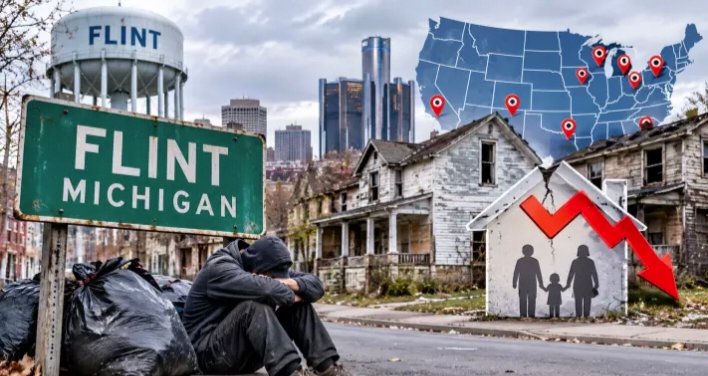
Several American cities are not merely stagnating. They are steadily shrinking. A new analysis by SmartAsset has identified eight US cities experiencing significant declines in their workforces, populations and, in many cases, housing stock.
According to a report by the New York Post, the analysis examined data from 2019 to 2024. During that period, the US workforce grew by approximately 2.8 percent, while the national housing stock increased by around 5.1 percent.
Although the reasons vary from city to city, a common factor is heavy dependence on a single industry or major employer. When that economic foundation weakens, the effects can spread throughout an entire community.
An ageing workforce, coupled with a shortage of younger workers to replace those retiring, has further contributed to the decline.
Flint, Michigan: The Hardest-Hit City
Flint ranks as the worst-performing city in the analysis. Its workforce fell by approximately 18 percent, from 41,611 to 34,193 people, marking the steepest decline among the eight cities.
The city also lost approximately 8,800 housing units, a decrease of 16.7 percent. Its population dropped from 95,541 to 79,727, while the unemployment rate increased from 10.8 percent to 12.2 percent.
Mayor Sheldon Neeley told local broadcaster WNEM that Flint’s population had been declining year after year following job losses at General Motors and the United Auto Workers. The COVID-19 pandemic and the city’s water crisis accelerated the trend.
However, city officials say the decline has slowed. Census estimates indicate that Flint recorded a population increase of 76 residents for the first time in 25 years.
Scranton, Pennsylvania: An Ageing Workforce
Scranton ranks second on the list. Known as the setting for the television series The Office, the city experienced a 12.5 percent decline in its workforce, bringing the total to 32,462.
Its population edged down to 75,915, while its housing stock declined by 3.9 percent.
One of the major factors behind the decline is an ageing population. Younger workers are not entering the workforce in sufficient numbers to replace those retiring.
Despite these challenges, the surrounding Lackawanna County economy has been growing at approximately 0.9 percent annually. Colleges, three hospitals, warehouses and a military facility producing 155mm artillery shells for Ukraine have contributed to the regional economy.
Beaumont, Texas: Businesses Recover, Residents Stay Away
Beaumont’s workforce declined by 6.1 percent to 52,189. The city also lost approximately 3,250 housing units, while its population fell to 112,888.
Hurricane Harvey, which struck the region in 2017, played a significant role in the city’s demographic changes. Although businesses recovered relatively quickly, many residents never returned, partly because of fears of future storms.
Meanwhile, manufacturing output in Jefferson County has continued to grow at approximately 0.7 percent annually. The contrast highlights a growing challenge: industrial activity can recover even as the population continues to shrink.
New Orleans, Louisiana: More Homes, Fewer Residents
New Orleans has lost more than 27,000 residents, bringing its population down to 362,701. Its workforce declined by 10.3 percent to 184,266.
Interestingly, the city’s housing stock increased by 2.4 percent to 196,906 units. This means more housing is available despite a shrinking population.
Local demographer Allison Plyer said the availability of well-paying jobs ultimately determines where people choose to live.
Civic leaders have also raised concerns about flood protection and rising insurance costs, both of which could make living in the city increasingly difficult.
Memphis, Tennessee: Employment and Population Under Pressure
Memphis, home to FedEx, has experienced significant workforce and population losses.
Its workforce declined by more than 23,000 people, or 7.2 percent, to 299,409. The city’s population fell by more than 40,000 to 610,936, while approximately 9,700 housing units were lost.
The surrounding Shelby County recorded the largest population loss of any US county in 2023-24, losing 3,379 residents.
Memphis began experiencing population decline after it stopped annexing surrounding areas. Between 2020 and 2025, it was the only city among Tennessee’s 10 largest cities that did not record population growth.
Mayor Paul Young has identified reversing the decline as a top priority, linking the city’s future to improvements in public safety and employment opportunities.
Lawton, Oklahoma: Dependence on a Military Base
Lawton’s economy is heavily dependent on Fort Sill, a major US Army installation.
The city’s workforce declined by 7.5 percent to 44,165. Its population stood at 90,039, while its housing stock fell by 2.3 percent.
According to a profile by Cameron University, Lawton has been losing residents since 2010, partly because of military and civilian job cuts at the base. Young adults in their twenties have been particularly likely to leave.
Local leaders are now looking to defence-related investment to strengthen the economy.
Two facilities operated by Leidos are expected to create approximately 130 jobs, while a $45 million manufacturing plant planned by Firehawk Aerospace is expected to generate around 100 jobs.
Waterloo, Iowa: A Different Pattern
Waterloo stands out from the other cities on the list.
Although its workforce declined by 2.2 percent to 36,136, its population edged up to 67,471. Its housing stock also increased by 0.7 percent.
The city’s economic fortunes are closely tied to agricultural equipment manufacturer John Deere.
Amid a downturn in the agricultural economy, the company laid off 1,075 workers in 2024 and another 932 in 2025. In October, however, it announced plans to recall 275 workers in Waterloo.
Despite the development, Black Hawk County’s gross domestic product has been contracting at approximately 0.8 percent annually.
Toledo, Ohio: Housing Stock Shrinks Amid Industrial Job Cuts
Toledo recorded a relatively stable workforce, which edged up slightly to 132,557. However, the city has experienced a substantial decline in its housing stock.
More than 7,500 housing units, or 5.5 percent, were removed, leaving 131,630 units. Its population stood at 265,651.
Much of the housing decline has been deliberate. Since 2022, the city has demolished 1,155 houses as part of efforts to remove abandoned and deteriorating properties.
However, state grants and federal pandemic-era assistance have dried up, while a proposed public safety tax was rejected. The mayor now wants to scale back the demolition programme.
Even so, another 449 properties remain on the demolition list, with each demolition costing an average of approximately $15,000.
David Mann, head of the Lucas County Land Bank, said the organisation would continue demolitions using its own budget when necessary.
Toledo is also facing pressure from the automotive industry. In January 2025, Stellantis indefinitely laid off 1,100 workers at its Jeep Gladiator plant, reducing the factory’s workforce from approximately 4,400 to 3,300.
The findings highlight the challenges facing American cities that depend heavily on a limited number of industries and major employers. As jobs disappear and younger workers move elsewhere, reversing population decline is becoming an increasingly difficult task.





Like our facebook page
Subscribe our YouTube channel