


 /
/ 
 Print
Print
Michigan is more than the “Motor City” state. Known as the birthplace of the American automobile industry through Ford, General Motors and Detroit, the state also represents a changing America shaped by immigration, working-class politics, racial and religious diversity, and shifting voter loyalties.
Surrounded by the Great Lakes, Michigan has long been home to immigrant communities. European workers once powered Detroit’s factories, while immigrants from Asia, the Middle East, South Asia and Africa have since reshaped the state’s social and economic landscape. Dearborn is perhaps the clearest example, where Michigan’s industrial past intersects with a growing immigrant America.
In the 2024 presidential election, Donald Trump won Dearborn, marking the first Republican victory there since 2000, according to the Associated Press. A significant factor was frustration among some Arab-American and Muslim voters over Democratic policies toward Gaza and the Middle East.
The shift underscored a broader political reality: Michigan’s Muslim and Arab-American voters can no longer be viewed as permanently aligned with one party. Pew Research Center data from 2023–24 showed that 53% of Muslim Americans leaned Democratic, while 42% leaned Republican, narrowing the gap compared with previous years.
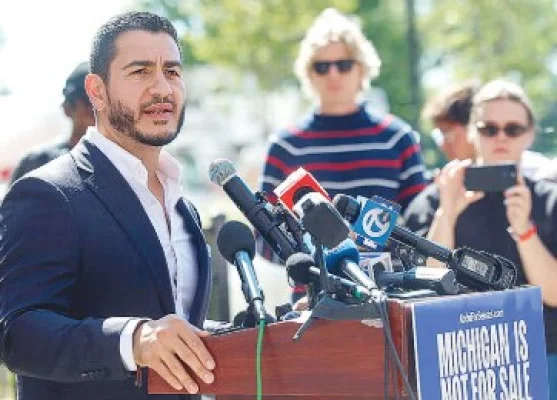
That political shift has taken on a new dimension with Abdul El-Sayed. The former public health official and progressive Muslim Democrat narrowly defeated Congresswoman Haley Stevens in the August 5, 2026, Democratic Senate primary. If he wins in November, El-Sayed would become the first Muslim senator in U.S. history.
His victory has highlighted the growing political influence of Muslim, Arab-American, younger and progressive voters in Michigan. But it has also triggered attacks from Republicans.
Republican campaigns have used his full name, Abdur Rahman Mohamed El-Sayed, in advertisements and portrayed him as an “extremist” candidate. Some attacks have attempted to associate him with terrorism, though no evidence has been presented to support those claims.
El-Sayed has responded by emphasizing his Michigan identity, saying he grew up as “Abdul” and that Michigan is one of the best places in the world to be Abdul.
The political environment has also been accompanied by rising concerns over Islamophobia and antisemitism. A report by The Appeal, citing the Center for the Study of Organized Hate, said anti-Muslim posts increased twentyfold following the primary. A Michigan survey found that 57.2% of voters believed Islamophobia against Muslim Americans had increased over the previous two years, while 58.7% said antisemitism had also increased.
Michigan’s electorate, however, remains difficult to categorize. The same voter may be a factory worker, a mosque-goer and a parent concerned about local schools. On Election Day, voters often weigh issues across party lines.
That has made Michigan one of the most important “purple states” in American politics, with both Democrats and Republicans capable of winning.
The state narrowly backed Trump in 2016, shifted to Joe Biden in 2020 and returned to Trump in 2024. In this year’s Senate race, El-Sayed faces Republican former Congressman Mike Rogers.
Recent polls show a highly competitive contest. A Michigan State University survey conducted August 10–20 found El-Sayed leading Rogers 48% to 44% among registered voters. An Emerson College poll conducted September 12–14 put El-Sayed ahead 48% to 46%. A Marist poll from September 24–27 showed El-Sayed leading 51% to 44% among registered voters. A Fox News poll conducted September 24–28 showed a much closer 50% to 49% race among likely voters.
The Fox News survey also indicated a significant shift in the race: Rogers had led by four points in August, but El-Sayed had moved ahead by late September.
The governor’s race is also drawing attention. Democrat Jocelyn Benson has maintained leads over Republican John James in recent polling, although Michigan voters have demonstrated a willingness to change their minds late in campaigns.
Economic conditions, the cost of living, immigration, the war in Gaza and U.S. policy toward the Middle East, as well as the actions of the Trump administration, could all influence the final outcome.
For Democrats, the challenge is to maintain a coalition that includes traditional working-class voters, Black voters, young progressives, Muslim and Arab-American communities, and moderate suburban voters.
Republicans, meanwhile, continue to benefit from support for Trump’s hard-line immigration policies and cultural politics, but those same positions could alienate other segments of the electorate.
Michigan’s politics, much like the automobiles that made Detroit famous, has a powerful engine—but the road ahead is rarely straight.
As autumn leaves cover Michigan’s roads, factory smokestacks, mosques and the memories of organized labor all remain part of the state’s political landscape. Campaigns may dominate the conversation, but the ballot box will deliver the final answer.
The question is whether that answer will determine only who wins Michigan—or offer a broader indication of where America’s rapidly changing political future is headed.



Like our facebook page
Subscribe our YouTube channel